How to Know What Gen Your Glock Is
Permit'southward clear up the confusion…
A very mutual question for new Glock buyers is "What Gen is my Glock?" Prior to the release of the 4th generation, Glock did not officially recognize whatsoever more than model numbers, contributing to the notion that "A Glock is a Glock is a Glock–They're all the same." Just early collectors noticed the differences and informally settled on three major iterations, or "generations," by which to classify. The nomenclature became so common that Glock followed suit with the release of Gen 4 in 2008 and their promotional literature now highlights earlier Gens in some places.
The pics below volition help you clearly place which generation your Glock is a part of, but annotation that at that place is a great bargain of overlap as models were transitioned slowly. Likewise, 3rd gen guns are still in production due to California's handgun restrictions then y'all could have a gen 5 gun that is actually older than your gen 3! The notes on the pics identify the major characteristics that are consistent throughout the generation, but modest changes to markings and internal parts can be found at dissimilar intervals–and sometimes dorsum and along–within the aforementioned Gen. Thus the hard breaks between generations only designate significant frame revisions, with many parts beingness interchangeable across ii or more, but some changes only lasting through a short run within a generation.
Gen 1

Click here for further breakdown
The 1st generation was ane of abiding alter. The initial design, while reliable, was withal under evolution. Early guns featured a slimmer butt that was stainless steel without the after parkerized stop. Several variations be in magazine, case, and small internal parts. All guns volition have Austrian proof marks, just not consequent placement or number of marks. Very early (pre-US) guns also do not have a serial number plate in the frame. Most early guns were likewise fitted with target sights that accept come up to be called "Weakend Sights" because of their fragility. Standard (stock-still) sights are too period correct, though the target version will fetch a premium. All frames had a half-moon mag well relief in the bottom of the front straps except the few 19s that were fabricated.
| Models | 17-xix |
| Product Span | 1982-1988 |
| Calibers | nine×19, 9×21 |
| Common Characterics | Pebblestone Texture |
| two-pivot Design | |
| Smooth Dust Embrace | |
| Mag Well Relief |
Gen 2

The 2nd Gen is what many novice collectors or even un-informed dealers will refer to as a "Gen 1." The defoliation stems from 2 factors: one. 1st Gens are very rare and not everyone has seen ane earlier. 2. Many models were introduced in the 2nd Gen line and some consider them to be "1st Gen" because information technology is the get-go outcome of that particular model. The articulate distinguisher betwixt 1 and two is the checkering added to the front and dorsum strap equally well every bit the change to the texture of the side panels (deeper than the 1st Gen). Gen 2 also saw the introduction of v additional calibers and all non-.380/9mm guns were fitted with a second locking block pivot to prevent frame smashing from heavier recoil. Full size frames carried over the magazine well relief at the bottom of the front strap.
| Models | 17-33 |
| Production Span | 1988-1998 |
| Calibers | ix×19, 9×21, .357 SIG, .40 Southward&W, 10mm, .45 ACP |
| Common Characterics | Side Grip "Panels" |
| Checkered Front/Back Strap | |
| Smooth Dust Cover | |
| Mag Well Relief |
Gen 3
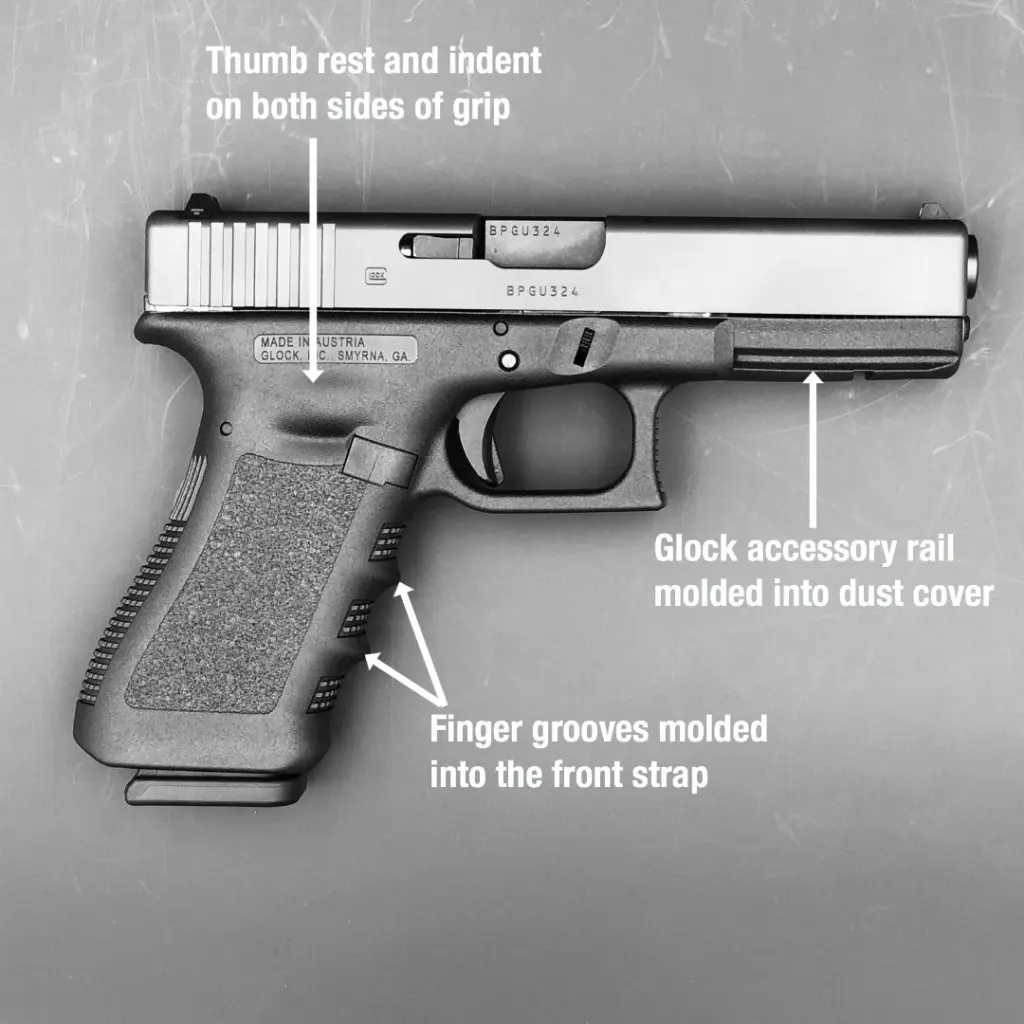
By the late '90s, Glock had become a ascendant force in the American gun marketplace and other articles were scrambling to copy the design. This led to some pressure to "innovate" the Glock pattern to try to keep ahead of the pack. The Gen 3 changes really started with the release of sub-compact models in 1995. Information technology was believed that the grip would be too pocket-size for many to hold on to then finger grooves were molded into the forepart strap to try to increase purchase and stave off rotation due to recoil. This started a three yr period of transition until the full changes reached all models in '98. Some of the larger frame transitional models are quite rare (especially in ported variations)–run across the <a href="https://glockhistory.com/transitional/">rare list</a> for more info.
| Models | 17-39 |
| Production Span | 1997-Nowadays |
| Calibers | .380 ACP, 9×19, 9×21, .357 SIG, .40 Southward&Westward, 10mm, .45 GAP, .45 ACP |
| Common Characteristics | Finger Grooves in Front Strap |
| Accessory/Light Runway |
Gen 4

By the time the 4th generation rolled out, Glock had become a dominant force in the American handgun market. The 4th generation was actually inspired by other manufacturers who had built copies or competitors to the Glock design only with slight tweaks to effort to steal market share. One of the fads that caught on was interchangeable back straps. Glock outset experimented with narrower grips in the Gen 3 SF models (but these were only bachelor in .45 and 10mm calibers). The modular backstrap organization brought SF proportions to all the frames with two up-sizing options and even beaver tail adapter inserts. The internals were re-designed from the basis up and were actually built with the .40S&Due west recoil contour in heed then scaled down for 9mm (where Gen one-3 were the opposite). This should prove to be longer lasting in the .40 models while continuing the legendary reliability of the 9s. The grip texture was also changed with more aggressive patterns on the side panels–this, again, was first experimented with in a brusk run of late Gen 3 guns with the so-called "RTF2" texture which was softened for a slightly less "grippy" Gen 4 design.
| Models | 17-41 |
| Production Span | 2008-Present |
| Calibers | .380 ACP, 9×19, ix×21, .357 SIG, .40 Due south&Due west, 10mm, .45 GAP, .45 ACP |
| Common Characteristics | Finger Grooves in Forepart Strap |
| Accessory/Light Rail |
Gen 5
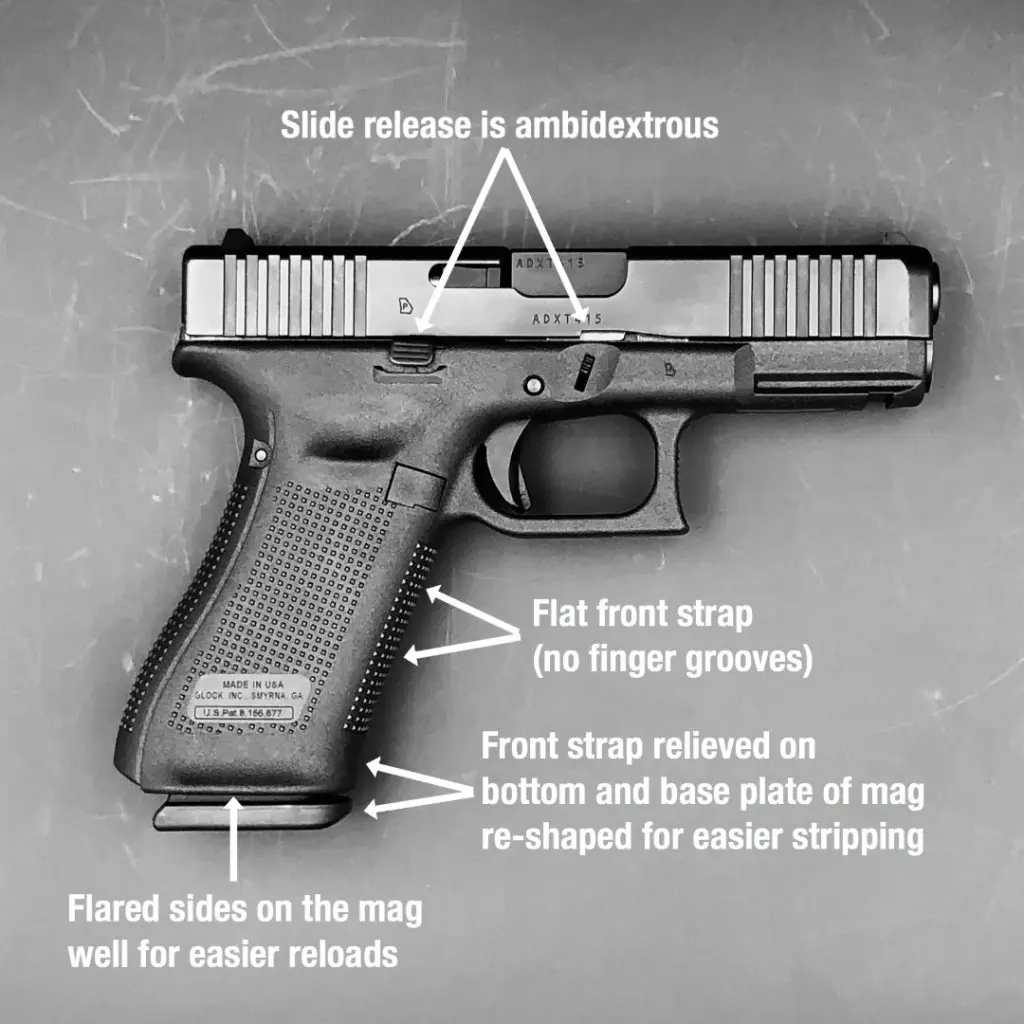
The outset Gen five models were actually preceded by the release of new subcompact slim-line models 42 & 43. These models started as ground up redesigns with all new internal components to adjust for the smaller dimensions. A lot of the features for these smaller guns were carried over to the full size Gen 5s. Models 19X, 42, 43, 43X, 44, 45, and 48 technically do not deport a Gen 5 designation on the slide, but neverless nearly closely align with the other Gen 5 guns. The 17 and 19 were officially released as Gen 5s in 2017 and take been followed by the other 9mm and .40 S&Due west offerings but thus far no .357 Sig, 10mm or .45 cal offerings have been produced. The major changes of notation include the "marksman" barrel and ambidextrous controls.
| Models | 17, nineteen, 19X, 22, 23, 26, 27, 34, 35, 42, 43X, 44, 45, 48, Too MOS versions |
| Production Span | 2017-Present |
| Calibers | .22 LR, .380 ACP, 9×19, .xl |
| Common Characteristics | Finger Grooves in Front Strap |
| Accessory/Light Runway |
gonzalezcrigoithave.blogspot.com
Source: https://glockhistory.com/what-gen-is-my-glock/

Post a Comment for "How to Know What Gen Your Glock Is"