Will My Dog Walk Again After a Herniated Disk
What is a disc, and what is its purpose?
The spinal cord is one of the virtually important and sensitive organ systems in the body. If it is damaged, the nervus cells exercise not regenerate but are replaced with fibrous or scar tissue. Spinal cord injuries usually result in permanent, irreversible harm. To protect it from damage, the spinal cord runs through a bony canal within the spine and is surrounded past protective bone everywhere except the junction of the vertebrae. These junctions are filled by rubber-like cushions called intervertebral discs. The individual vertebrae and intervertebral discs allow the back to motility upwards and down and sideways without allowing contact betwixt the basic of the spinal column. This farthermost protection of the spinal cord reflects its importance and fragility.
What does it mean for a disc to rupture, and how does information technology happen? 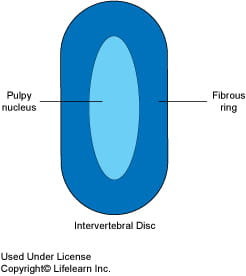
"The disc is equanimous of two parts."
The disc is equanimous of 2 parts. The outer covering (fibrous ring) is much like a thick trounce. It is comprised of tough fibers that protect and comprise the cardinal part (pulpy nucleus). The disc is thinnest at the superlative. This thin area is located simply below the spinal cord. The central part of the disc is much softer than the outer function and has the consistency of thick toothpaste.
Degenerative disc disease causes spontaneous degeneration of the outer function of the disc, resulting in sudden disc rupture or herniation (likewise called a "slipped disc"). It may not be related to injury, although the rupture frequently occurs subsequently some sort of traumatic outcome, such as a fall or a relatively small jump.
Although this deed is frequently blamed for the disc rupture, the injury actually occurred due to chronic disc degeneration. Nigh dogs with degenerative disc disease are middle-anile, from three to seven years old. There is likely a genetic predisposition to this disease. Certain breeds, particularly the Dachshund, Poodle, Pekinese, Lhasa Apso, German language Shepherd Dog, Doberman, and Cocker Spaniel accept a loftier incidence of intervertebral disc disease.
"Because the spinal cord is encased within its bony canal, information technology cannot move away from the pressure level and it becomes 'pinched'."
When the outer beat out degenerates, it allows the key function of the disc to escape. Since the disc is thinnest almost the spinal cord, disc material that escapes through the tear commonly goes upwardly, putting pressure on the spinal cord. Because the spinal string is encased within its bony canal, information technology cannot movement away from the pressure and it becomes "pinched".
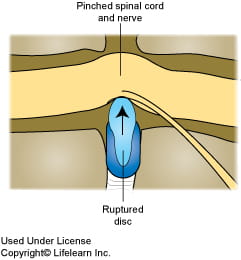 How does a slipped disc affect the spinal string?
The spinal cord is like a telephone cable carrying thousands of tiny wires. When it is crushed, transmission of data through the wires is slowed or stopped. When the disc degenerates and ruptures, it crushes the spinal cord and the nerves that leave the spinal cord over the discs (i.e., spinal nerves). Force per unit area on the spinal nerves results in pain. Pressure level on the spinal cord results in pain and/or loss of information transmission, causing partial or complete paralysis, along with other neurological deficits.
Most disc ruptures occur in the middle to lower part of the back. However, they may as well occur in the cervix. Dorsum injuries often cause paralysis without astringent pain while neck injuries usually cause severe hurting without paralysis. If paralysis affects all 4 legs, the disc rupture must be in the neck. Due to the way nerve tracts are arranged in the spinal string, disc ruptures in the neck may touch on the rear legs first and may not involve the front limbs.
How fast exercise intervertebral discs degenerate and rupture?
"Some dogs will go from normal walking to full paralysis in less than one hour."
Disc degeneration occurs relatively slowly, and a rupture may occur slowly and gradually, and then that degenerated disc material slowly escapes from the disc over several days or weeks. In these cases, the domestic dog often experiences pain and is reluctant to move. It may lie around for a few days allowing the body to endeavor to heal the injury, often without the owner being aware that a problem existed. Withal, discs may also rupture very acutely. Some dogs will go from normal walking to total paralysis in less than one hour.
How is a slipped disc diagnosed?
A presumptive diagnosis of disc disease volition be based on the dog'southward history of neck or back pain, uncoordinated walking, or paralysis, with or without a history of recent trauma. If the dog is one of the high incidence breeds, this disease will be high on the list of potential causes of the patient's symptoms. 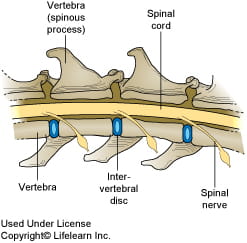
"...a myelogram may be performed."
In some cases, plain radiographs (X-rays) may aid the diagnosis. However, plainly radiographs may testify no abnormalities, since neither the disc nor the spinal cord is readily visible on an X-ray. If the diagnosis is in dubiety or if the patient will undergo surgery, a myelogram may be performed. This procedure involves injecting a special dye around the spinal cord of the anesthetized dog and then taking a series of X-rays. The dye volition outline the spinal cord. A break in the dye cavalcade means that at that place is pressure on the spinal string at that bespeak. If bachelor, computed tomography (CT) scans and magnetic resonance imaging (MRI) may be used to diagnose intervertebral disc herniation.
How practice you know if the pressure on the spinal cord is due to a disc or something else?
It is possible that the force per unit area on the spinal cord is due to a blood clot or tumor. Both are possible simply rare, especially when compared to disc ruptures. If the patient is a loftier-run a risk breed and there has been a sudden onset of paralysis without severe trauma, in that location is an approximately 95% chance that a disc rupture is causing the clinical signs. However, the diagnosis is non definite until the fourth dimension of surgery.
Are all disc ruptures treated with surgery?
Not necessarily. The recommended treatment is based on the stage of the affliction:
- Stage I disc disease produces mild pain and is normally self-correcting in a few days.
- Phase Ii disc affliction causes moderate to severe pain in the cervix or lumbar (lower back) area.
- Stage Iii disc disease causes partial paralysis (paresis) and results in the dog walking in staggering or uncoordinated movements.
- Stage Iv disc disease causes paralysis but the power to feel is present.
- Stage V disc affliction causes paralysis and loss of feeling.
These stages tend to overlap in some dogs, and dogs may move from one phase to another over a period of hours to days. Dogs with Stage Two and Iii disease are unremarkably treated with anti-inflammatory drugs, pain relievers, and exercise brake. If the pain or lack of coordinated movements persists after four to vii days of treatment or if the neurological status declines from one 24-hour interval to the next, surgery may be required. The time of confinement will vary based on each patient's condition.
Dogs with Stage IV disease should have surgery, although a minor percent will recover without information technology. Dogs with Stage V disease should have surgery immediately. The sooner that surgery is done, the meliorate the prognosis. Ideally, these dogs should be operated on within the first 24 hours of the onset of paralysis.
What is the purpose of surgery?
"The goal of surgery is to remove pressure from the spinal cord."
The goal of surgery is to remove pressure from the spinal cord. If the disc rupture occurs in the lower back, a "window" (called a fenestration) is made in the side of the vertebral bone to expose the spinal string. This window allows removal of disc cloth and relieves pressure from the cord. If the disc rupture occurs in the neck, a window is made in the bone exposing the spinal cord. This may exist done from either the top or the lesser, depending on the situation and the veterinarian's preference.
What is the success rate for treating disc disease with and without surgery?
Stage Recovery without Surgery Recovery with Surgery I: up to ane week eighty-90% xc-95% II: past one week 60-70% 90-95% III 30-twoscore% 85-95% IV: up to 3 days < 25% 85-95% IV: by 3 days < 20% threescore-70% V: upward to 24 hours < five% fifty% V: past 24 hours < v% < 20%
When will we know if the surgery is successful?
Unfortunately, success cannot be determined immediately. The return of neurological role, walking ability, and relief from hurting may non occur for several days to weeks subsequently surgery.
When can my dog go habitation? 
Following surgery, your domestic dog will exist hospitalized for several days. Float and bowel command are often lost when the dog is paralyzed. Information technology is better for your canis familiaris to remain hospitalized until control of these functions has returned. It is generally improve not to extend hospitalization across vii days considering regaining the ability to walk partly depends on exercise and motivation. Since motivation is such an of import office of the recovery process, nosotros encourage you lot to visit your dog starting a few days after surgery.
"Recovery is dependent on four factors: whether permanent harm was washed before surgery, if the surgery relieved the pressure quickly enough, if physical therapy tin can be performed at dwelling, and if the dog is motivated to recover."
If paralysis was present before surgery, your dog may non be able to walk when it is discharged from the hospital. You will be given detailed instructions on the procedures that should be performed. Recovery is dependent on four factors: whether permanent harm was done before surgery, if the surgery relieved the force per unit area quickly enough, if physical therapy can be performed at home, and if the dog is motivated to recover.
Can my canis familiaris slip a disc again?
The answer is "aye". However, as discussed in a higher place, non all disc herniations require surgery.
What if the myelogram is normal?
The purpose of the myelogram is to identify pressure on the spinal cord. If the myelogram is normal, there is no pressure on the spinal cord. This has several of import implications. Start, it ways that surgery volition generally not exist appropriate. Second, it means that i of the post-obit atmospheric condition is likely to be:
Spinal Shock. This is a temporary loss of spinal function that is generally associated with trauma. It occurs suddenly and is somewhat similar a concussion of the brain. It may exit permanent harm or full recovery may occur. Recovery from spinal daze more often than not occurs inside a few hours to a few days.
Fibrocartilaginous Embolism. In this condition, a small amount of disc cloth ruptures and gets into i of the blood vessels leading to the spinal cord. As the vessel narrows, the disc material obstructs it, depriving a certain segment of the spinal cord of its blood supply. Without proper blood supply, that segment of the spinal cord dies, resulting in paralysis. Surgery will not assist these dogs because there is no pressure on the spinal string. Oft, paralysis involves only one rear leg, or one rear leg is more than severely affected than the other is. Complete recovery may occur in a few days to weeks, or in that location may be permanent harm to a portion of the spinal string. Diagnosis of fibrocartilaginous embolism is based on the right clinical signs and a normal myelogram. Unfortunately, a definitive diagnosis tin can only be made by performing a spinal cord biopsy after death.
Degenerative Myelopathy. This is a condition where the spinal cord is slowly dying. It results in progressive paralysis that begins with the canis familiaris dragging its rear feet as it walks. This is called "knuckling over" and results in the toenails of the rear feet being worn because they elevate the ground with each footstep. It progresses to weakness of the rear legs, and then paralysis. Information technology generally takes several weeks before paralysis occurs, and more often than not occurs in large breeds of dogs, especially German shepherd dogs. It is frequently referred to as "German Shepherd Dog Affliction" or "Alsatian Disease". In that location is no treatment and ultimately causes loss of urine and bowel control. Diagnosis of degenerative myelopathy is based on clinical signs, breed and a normal myelogram. Confirmation requires a biopsy of the spinal cord at fourth dimension of death (for further data on this illness, delight see the Client Educational activity Handout "Degenerative Myelopathy").
"A normal myelogram in a domestic dog with slowly progressive paralysis is very frustrating..."
A normal myelogram in a dog with slowly progressive paralysis is very frustrating because the two most probable diseases, Fibrocartilaginous Embolism and Degenerative Myelopathy, cannot be confirmed without a necropsy (an autopsy on an animal).
gonzalezcrigoithave.blogspot.com
Source: https://vcahospitals.com/know-your-pet/degenerative-disc-disease-in-dogs
Post a Comment for "Will My Dog Walk Again After a Herniated Disk"